Dark Matter

When you look up at night, you see myriads of stars spread across the sky. When astronomers look into the deepest reaches of the universe with powerful telescopes, they see myriads of galaxies, organized into large clusters and other structures. This might lead you to believe that the universe is composed mainly of galaxies, stars, gas and dust – things that you can see. However, most astronomers believe that visible matter makes up only a small fraction of the mass of the universe. The majority of the universe is made of stuff we can’t see – so-called dark matter.

Dark matter

Continue reading

Fibonacci sequence

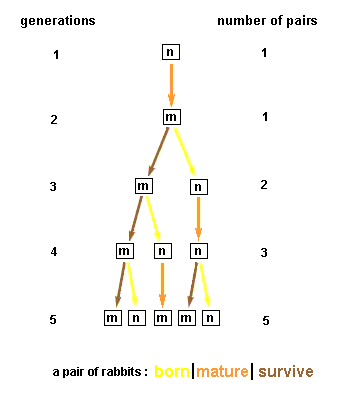
Medieval mathematician and businessman Fibonacci (Leonardo Pisano) posed the following problem in his treatise Liber Abaci (pub. 1202):

How many pairs of rabbits will be produced in a year, beginning with a single pair, if in every month each pair bears a new pair which becomes productive from the second month on?

This problem can be illustrated in such way:

Fibonacci problem

Continue reading

String theory – quantum mechanics and astronomy at one scale.

The whole thing begun in 1968 when Gabriele Veneziano, who worked at CERN in Geneva, discovered that the Euler Beta function is quite suitable to explain the physical properties of strongly interacting particles. Working further on this concept scientist all over the world came to a conclusion that all observed elementary particles in fact are vibrating 1-dimentional closed circuit strings. The more intensive the vibration – the more massive particle we will observe. After the years of theoretical research this simple idea transformed into a so called “string theory”, one of the most complicated and promising branch of modern theoretical physics and astrophysics. Continue reading